You did not pick that ring randomly.
You tell yourself you did. You were scrolling, you saw it, something pulled you in. But the psychology of jewelry says otherwise. The pieces you reach for consistently, the ones you cannot leave the house without, the ones you buy for yourself on days that matter, those choices are not random. They are revealing.
This is the part people do not talk about enough.
Why Do People Wear Jewelry: Psychology Behind It
Why do people wear jewelry? Not the historical answer. The honest one.
Because it makes them feel like themselves.
That is the psychology of jewelry in its simplest form. Before status, before occasion, before any social function, jewelry is a tool for self-recognition. You put something on and you look in the mirror and something clicks into place. You feel more 'you' than you did ten minutes ago.
Research in environmental psychology has consistently found that what we wear, including what we put on our skin and hands and neck, directly influences our cognitive and emotional state. It is called 'enclothed cognition.' The idea is not just that clothing signals identity to others. It signals identity to ourselves.
Why do people wear jewelry at its deepest level is about that internal signal. The ring on your finger is a reminder. Of something you value. Someone you are. A version of yourself you are choosing to inhabit today.
The psychology of jewelry is not superficial. It is the opposite of superficial. It is one of the most direct ways humans have ever communicated the interior to the exterior.
Jewelry Symbolism and Psychology Across Cultures
Jewelry symbolism and psychology have been linked across every civilization we have ever documented.
Ancient Egyptians wore specific stones to communicate connection to their gods. Roman soldiers wore amulets for mental clarity in battle. Medieval bishops wore amethyst to signal spiritual authority. Every culture has understood, instinctively, that what you put on your body says something about what is happening inside it.
Jewelry symbolism and psychology in contemporary culture is no different. We have just updated the vocabulary.
A maximalist stone ring on a woman who otherwise dresses quietly is a statement about an interior life that does not match the surface. A stack of mismatched rings built over years is a visual diary. A single bold pendant worn every day without exception is a declaration of something that matters, even if the wearer never explains it to anyone.
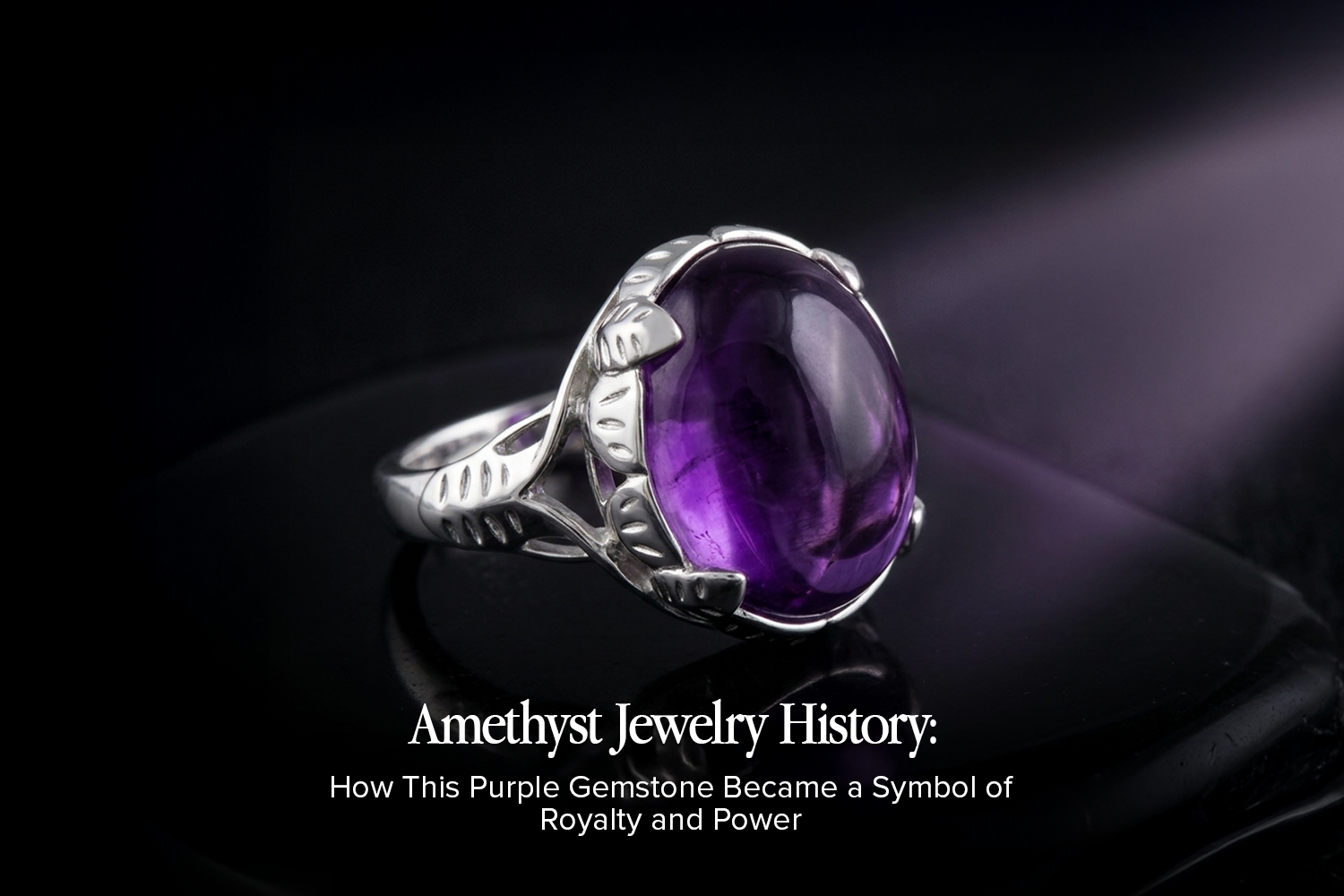
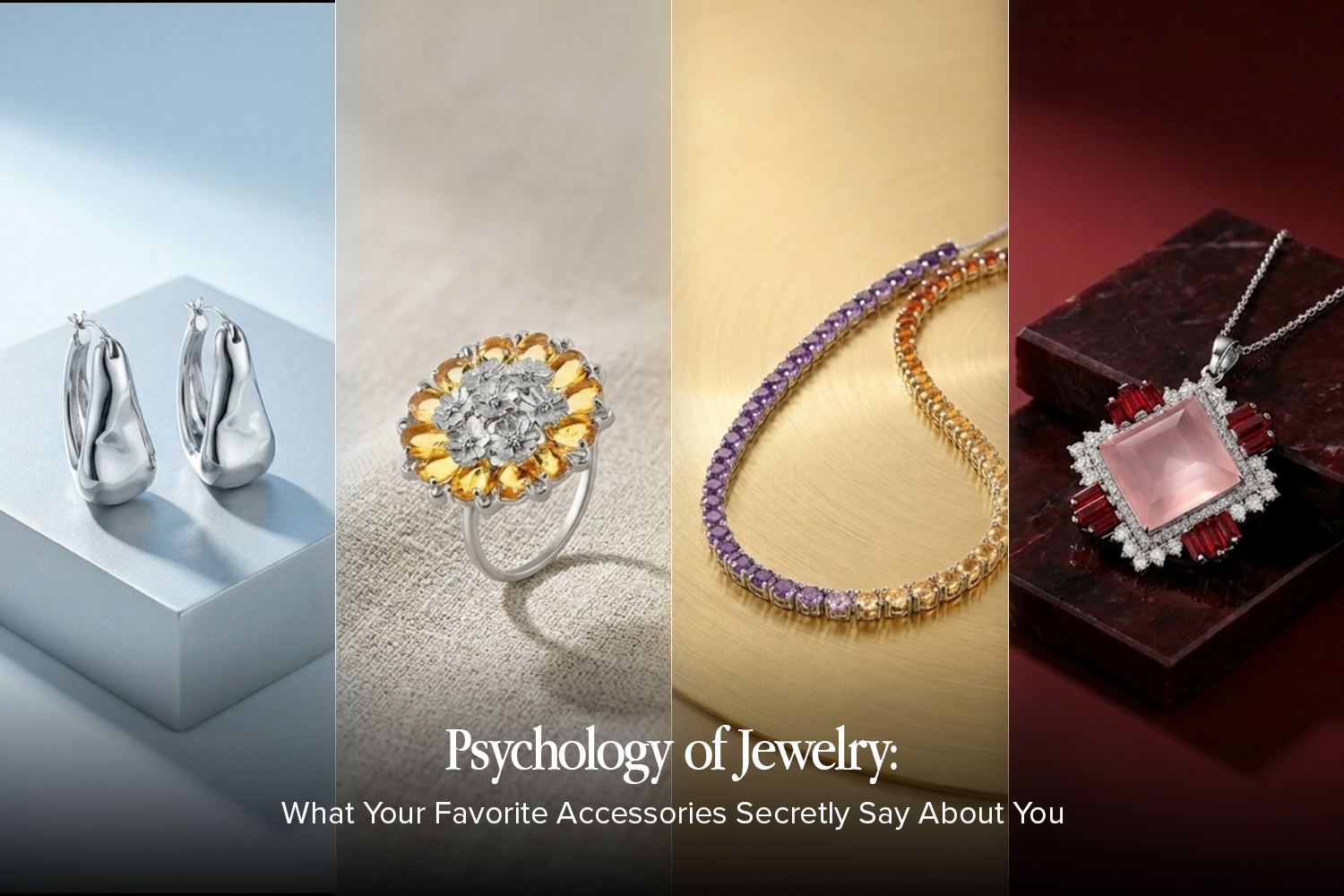
The Majestic Amethyst Halo Pendant carries this kind of psychological weight. Natural amethyst has been associated with clarity and calm across cultures for thousands of years. Wearing it is not just a style choice. For many people, it is a daily act of intention. The stone and the history it carries become part of what you are communicating when you walk into a room.
That is jewelry symbolism and psychology working exactly as it always has.
Jewelry and Self Expression: Reflecting Personal Identity
Jewelry and self-expression are so linked that researchers now study jewelry choice as a direct window into personality.
What you choose to wear tells people things about you that you might never say out loud.
Someone who gravitates toward bold, sculptural, natural stone pieces is usually communicating something about their relationship with depth and complexity. They are not drawn to the obvious. They notice things others miss. They find beauty in what took time to form.
Someone who reaches for the same piece every single day is communicating consistency. Loyalty to the things they love. An unwillingness to be swayed by what is trending this season.
Someone who layers pieces that come from different places and different times is communicating that their identity is built from accumulation, from experience, from the understanding that who you are is the sum of everywhere you have been.
Jewelry and self-expression through intentional craft is exactly what the Aurora Wisp Soul Pendant with natural citrine is built for. Citrine, a stone associated with warmth and inner fire, set in a form that captures the quality of light shifting through it. People who choose this piece rarely choose it for the occasion. They are choosing it because something in it matches something in them.
That is jewelry as self expression at its most honest.
Meaning Behind the Jewelry You Choose to Wear
The meaning behind the jewelry you choose to wear is not always something you can articulate immediately.
Sometimes you just know a piece is yours before you can explain why.
The psychology of jewelry suggests this is because jewelry choice operates partly below conscious reasoning. You are responding to color, weight, texture, and shape through pattern recognition built from years of understanding what feels right on your body and what does not. You are also responding to the narrative, even if you do not know the full story of a piece yet.
This is why the meaning behind the jewelry you choose to wear deepens over time. A piece you bought because you liked it becomes, over years of wearing it through significant moments, something much more layered. It absorbs meaning from the life lived while wearing it.
The Tatiana Petal Garnet Edition pendant works this way. Petite natural garnet clusters in fluid silver petals, hand-finished by artisans trained within a 35-year tradition of gemstone mastery. Someone chooses it initially because something about it resonates. Over time, it becomes the piece they reach for when they need to feel grounded. The meaning behind the jewelry you choose to wear is partly found, partly built.
Jewelry and Confidence Boost: Emotional Impact of Accessories
The jewelry and confidence boost connection is real.
Not metaphorically real. Physiologically real.
Studies in behavioral psychology have found that wearing pieces associated with positive self-concept increases confidence measurable in performance on tasks, in social interactions, and in how people carry themselves physically. Posture changes. Eye contact increases. The way you speak shifts.
The psychology of jewelry and confidence is not about the piece making you look better to others. It is about the piece reminding you of who you are when you need that reminder most.
This is why people have 'interview pieces' and 'difficult conversation pieces' and 'the ring I wear when I need to feel like myself.' These are not superstitions. They are psychological anchors.
A piece made with real craft, real stone, and real artisan attention carries more of this anchoring quality than one that does not. When you know something was made slowly, with skill, by someone who has spent decades learning the work, that knowledge travels with you. It changes how you hold the piece in your mind.
The jewelry and confidence boost is strongest when the piece feels genuinely earned. Not purchased on impulse. Chosen.
Personality Traits and Jewelry Style Choices
Personality traits and jewelry style are more connected than most people consciously realize.
Some patterns that show up consistently:
-
Bold, sculptural stone pieces: People drawn to maximalist jewelry with natural stones and intricate settings tend to be detail-oriented, comfortable with complexity, and resistant to the idea that simple is always better. They find depth interesting.
-
Consistent, daily-wear pieces: People who wear the same piece every single day tend to value meaning over novelty. They build strong attachments and prefer depth to variety.
-
Layered, accumulated stacks: People who build their jewelry look over time from multiple sources tend to be collectors by nature. They understand that identity is cumulative, not fixed.
-
Natural stone choices: People drawn to unprocessed, geological stones, druzy formations, larimar, chrysoprase, garnet, tend to have an intuitive relationship with authenticity. They can tell when something is real and when it is not, in jewelry and in people.
Personality traits and jewelry style are not a rigid formula. But they are a genuine reflection. The Natural Larimar Oversized Silver Ring from the Petrichor collection consistently attracts people who are drawn to calm, depth, and originality. Its sky-blue Larimar stone, found only in one place in the world, appeals to people who understand that rarity is not about scarcity marketing. It is about something being genuinely, geologically irreplaceable.
That is personality traits and jewelry style in its most honest form.
FAQs
Why do people wear jewelry from a psychological perspective?
Jewelry signals identity to the wearer first, before anyone else. It is an act of self-recognition, a daily choice that reinforces who you are and what you value.
How does jewelry reflect personality and identity?
The stones you choose, the weight you prefer, whether you layer or wear one piece alone, all of these reflect deeper patterns in how you understand yourself and communicate that self to the world.
Can jewelry influence confidence and mood?
Yes, and research supports it. Wearing pieces connected to positive self-concept activates psychological anchoring, changing posture, presence, and how you engage with the people and situations around you.
The psychology of jewelry is not a niche topic.
It is the reason you have a piece you cannot leave behind. The reason some rings feel like armor and some necklaces feel like a reminder. Explore the Aurora Wisp Orchid Pendant with natural amethyst and find the piece that says something only you fully understand.