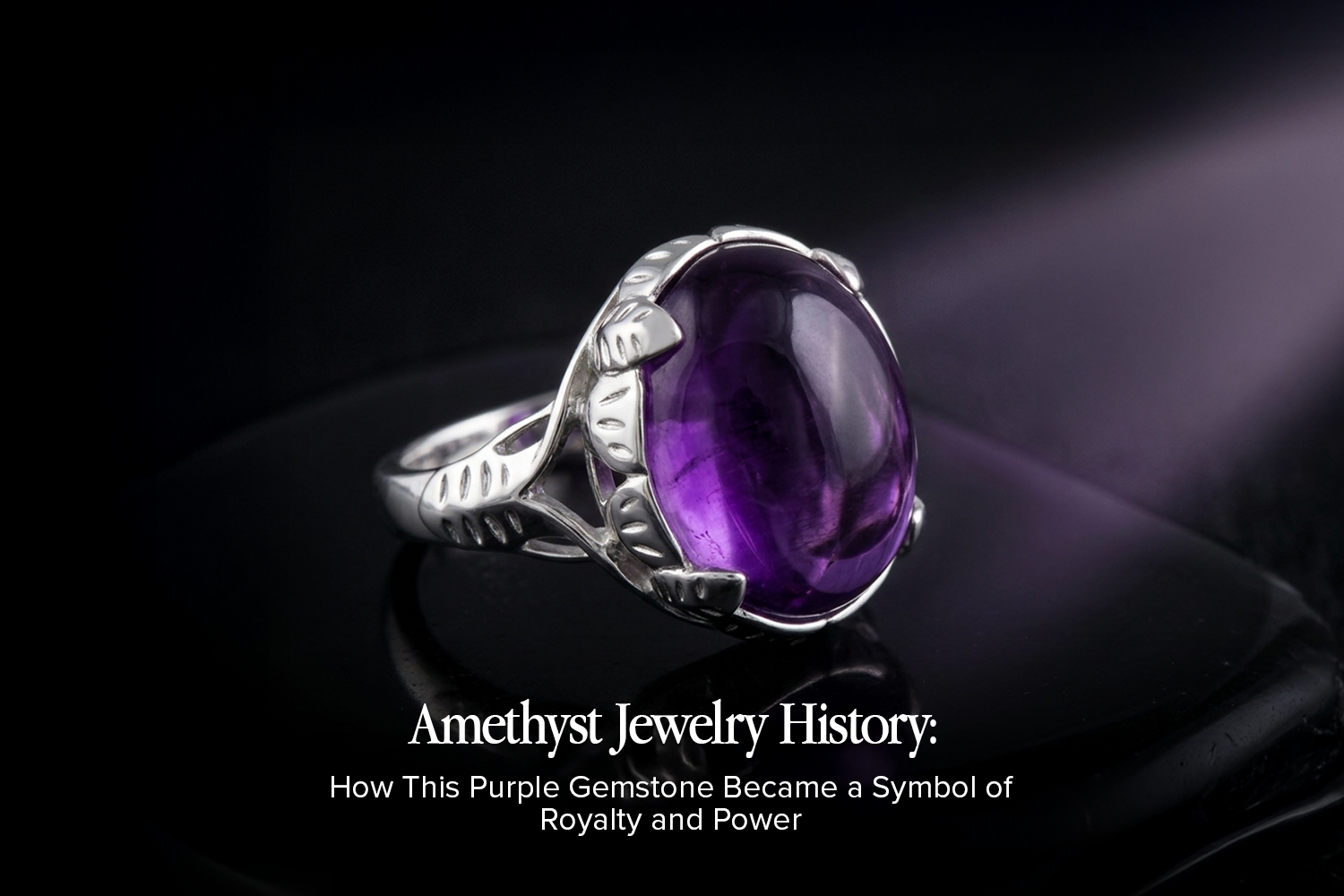
Nobody picks amethyst by accident.
You stop. You look. Something pulls you in. That deep violet, shifting between purple and wine depending on the light, has been doing exactly that to people for over 25,000 years.
Amethyst jewelry history is not just old. It is relentless. It kept showing up in the most significant places humans built, burial chambers, coronation halls, cathedral rings, warrior amulets. That does not happen without reason.
So let's actually talk about why.
Amethyst Stone History: Origins and Early Discoveries
Amethyst stone history starts earlier than most people expect.
Prehistoric sites in France show evidence of amethyst use dating back roughly 25,000 years. That is before writing, before organized religion, before cities. And humans were already reaching for this stone.
By the time ancient civilizations had words to describe what they felt wearing it, amethyst was already embedded in their rituals and their understanding of power. It was not decorative then. It was intentional.
The stone belongs to the quartz family. Its violet color which can read anywhere from pale lilac to a grape-dark, almost bruised purple comes from iron impurities activated by natural radiation over geological time. The process is slow. Hidden. Completely out of human hands.
What comes out the other side is a stone that holds light differently depending on the angle, the hour, the room you are standing in.
Artisans across 35 years of work at Bahlko's atelier understand this about amethyst. You do not set it and forget it. You set it to move with its wearer, to catch the light it was made to catch. That is a conversation that starts long before the stone ever meets the metal.
The name comes from the ancient Greek 'amethystos,' meaning 'not intoxicated.' The Greeks believed wearing this stone protected you from drunkenness. They carved drinking vessels from it. They wore amulets of it at feasts. Whether that was literal belief or cultural shorthand for 'this stone keeps your head clear,' the meaning stuck. Amethyst has always been understood as a stone that steadies things.
Amethyst in Ancient History: From Greece to Egypt
Amethyst in ancient history appears exactly where you would expect it.
Not in the market. Not in ordinary homes. In the places where power, belief, and ceremony lived together.
Egyptian goldsmiths set amethyst into gold amulets worn both in life and placed in burial chambers. They were technically extraordinary. Their understanding of how a stone behaves over time, how it sits in metal, how it holds its color through decades, was not guesswork. It was craft passed down through hands.
The Greeks connected amethyst to Dionysus, the god of wine and transformation. Which gave it a double meaning that is actually kind of interesting if you think about it. On one hand: protection from excess. On the other: an acknowledgment that transformation requires moving through something uncomfortable first. To wear amethyst in ancient Greece was to hold both of those things at once.
Rome took the stone into battle. Roman soldiers wore amethyst amulets for mental clarity under pressure. The stone was a status marker. A ring set with amethyst told you something real about the person wearing it.
By the medieval period, amethyst in ancient history had traveled deep into Christian Europe. Bishops wore amethyst rings as markers of their spiritual authority. Purple had always carried the weight of divine mediation. Amethyst, the most naturally and consistently violet of all available gemstones, fit into that language exactly. To receive a blessing from a bishop's hand was to receive it from a hand that wore centuries of accumulated meaning.
That lineage does not disappear when you put on an amethyst pendant from Bahlko's collection. It just becomes quieter. More personal. Yours.
What Does Amethyst Symbolize? Meaning Through the Ages
What does amethyst symbolize? Honestly, it depends on who you ask and when.
But some things show up across almost every culture that worked with this stone.
Clarity. Calm. The ability to think under pressure. Protection from confusion, from excess, from the kind of clouded judgment that comes when everything feels like too much.
In Tibetan Buddhist traditions, amethyst was considered sacred to the Buddha and used in prayer beads. In Hindu traditions, it connects to the crown chakra, the energy center associated with higher consciousness. In medieval Europe, it marked piety and spiritual authority. In ancient Greece, it protected you from losing your head at a dinner party.
Different contexts. Same core instinct. This stone is for people who want to remain themselves no matter what is happening around them.
What does amethyst symbolize today? The wellness world has brought it back into popular conversation as a stone of emotional balance. That is not wrong. But it is only part of the story. The history of this stone as a symbol of royalty, spiritual authority, and mental clarity means it carries something larger than a wellness trend. It carries lineage.
The Aurora Wisp Orchid Pendant crafted with natural amethyst at Bahlko holds that lineage in its stone. Each piece of natural amethyst is hand-selected. Not for uniform color, but for the particular quality of light that stone carries. That is not a detail people can fake after 35 years of gemstone work. You either know what you are looking for or you do not.
Amethyst Symbolism in History: Spiritual and Cultural Significance
Here is something worth sitting with.
Amethyst symbolism in history keeps appearing at thresholds.
Not in ordinary moments. In transitions. In burial chambers. In coronation ceremonies. In the rings of people who were about to become something different from what they were before.
That pattern is not coincidence. It reflects a consistent cross-cultural understanding: certain objects can hold intention across time. Certain stones carry the capacity to mark a shift. To say, something is changing here, and I am wearing the proof of that.
Amethyst symbolism in history is the history of people using physical objects to make invisible meaning visible. Which is, when you think about it, what jewelry has always been for.
At Bahlko, every piece of amethyst jewelry is built from that same understanding. Not with grand claims about what the stone will do for you. But with the certainty that a stone formed in darkness over millions of years, then brought into human hands with real skill and care, carries weight that a synthetic alternative simply cannot replicate.
The Majestic Amethyst Halo Pendant is a good example of this. A natural amethyst surrounded by a shimmering halo, hand-set by artisans working within a 35-year tradition of gemstone mastery. The setting is not just aesthetic. It is a decision about how much of the stone's depth should be visible. That requires knowing the stone. Actually knowing it.
History of Purple Gemstones in Royal Jewelry
Let's be real about something.
Purple was not a color that just happened to become associated with power.
Before synthetic dyes existed, Tyrian purple required extraordinary labor to produce. Sea snails, harvested in enormous quantities, processed through methods that were painstaking and expensive. The result was a color so costly that only the most powerful institutions could afford it. Emperors. High priests. The highest ranks of every court.
Amethyst was one of the only naturally occurring materials that carried that color without requiring the labor-intensive dye process. Which made it genuinely rare and genuinely powerful.
The history of purple gemstones in royal jewelry runs through the British Crown Jewels, through the personal collections of Catherine the Great, through centuries of European courts that understood what amethyst communicated before a word was spoken. A king wearing this stone was making a statement about authority that went beyond personal taste.
Before significant amethyst deposits were discovered in Brazil in the nineteenth century, the stone was scarce. Its primary sources were in Siberia, Sri Lanka, and select sites across the Middle East and Africa. Access required reach. Reach required power. The stone and the power became associated because they were genuinely linked.
That history of purple gemstones in royal jewelry is part of why amethyst continues to carry a particular weight. Not because we still live in a world of courts and crowns, but because certain associations accumulate over centuries and become part of what a thing means, whether you consciously know the history or not.
How Amethyst Became a Symbol of Power in Ancient Civilizations
Three things happened, roughly simultaneously, across multiple civilizations.
First, rarity. How amethyst became a symbol of power in ancient civilizations starts with access. Those who could get this stone were those who had the trade networks, the resources, and the reach to obtain it. Which meant those who already held significant power.
Second, color. Purple was already the established visual language of authority. Amethyst delivered that color from the earth itself, without human manufacture. That felt like something. It felt like legitimacy that could not be faked.
Third, belief. How amethyst became a symbol of power in ancient civilizations is also about the genuine belief that this stone did something. That it sharpened thinking. That it protected against corruption. That it connected the wearer to something larger than individual ambition.
An emperor who believes their amethyst ring connects them to divine authority behaves differently from one who does not. Belief, made visible in stone, worn on the hand that signs decisions and receives supplicants, has always been a form of governance.
This is not superstition. This is humans understanding that what you carry with you changes how you carry yourself.
Explore Bahlko's amethyst jewelry and find the piece shaped by that same understanding. Made by artisans who know this stone. Finished to a standard that honors what the stone has always meant.
FAQs
Q: What does amethyst symbolize in history?
Amethyst has long symbolized clarity, protection, and spiritual composure.It reflects a quiet strength rooted in staying grounded and self-aware.
Q: How was amethyst used in ancient civilizations?
It appeared in amulets, ritual objects, and adornments across cultures.Its role was both protective and deeply symbolic, not merely decorative.
Q: Why was amethyst considered a royal gemstone?
Its rarity and rich purple aligned with historic symbols of power. To wear it was to embody authority with a sense of inner balance.
Amethyst jewelry history is not a closed chapter.
Every time someone chooses this stone with any awareness of what it carries, the history continues. It just becomes more personal.
Explore Bahlko's amethyst jewelry, shaped by 35 years of gemstone mastery, and find the piece that belongs to your chapter of that story.