A crescent moon on a pendant. An eye pressed into a silver ring. A lotus flower carved into a pair of earrings. We wear these things without always knowing why, drawn to them for reasons we can't fully explain.
Popular jewelry symbols have been part of human culture for as long as people have been making jewelry at all. Long before a piece was worn for beauty, it was worn for meaning. For protection. For identity. For connection to something larger than the individual.
Understanding the stories behind popular jewelry symbols doesn't just make your jewelry more interesting. It makes the act of choosing and wearing it more intentional. And there's something genuinely compelling about knowing that the symbol on your wrist carries thousands of years of human history.
What Are Popular Jewelry Symbols and Why Do They Matter?
Popular jewelry symbols are motifs, shapes, and images repeated across jewelry design that carry cultural, spiritual, or personal significance beyond their visual form. A symbol is never just a shape. It's a shorthand for a whole world of meaning that people have collectively agreed upon over centuries.
Jewelry symbolism matters because it connects the personal to the universal. When you wear a symbol, you're participating in a tradition that stretches back through time and across cultures. The hamsa, the evil eye, the serpent, the lotus: these popular jewelry symbols appear in ancient Egypt, in South Asian temples, in Mediterranean markets, and in contemporary fine jewelry collections simultaneously. That kind of longevity is not accidental.
Jewelry symbols also function as private language. A piece that means something specific to you communicates that meaning in a way that's invisible to most people and deeply personal to you. That duality is part of what makes symbolic jewelry so enduring.
History of Jewelry Symbols: From Ancient Times to Today
The history of jewelry symbols is essentially the history of human belief. The earliest symbolic jewelry dates back over 100,000 years, with shell beads used as personal adornment and likely as markers of identity or status. By the time of ancient Egypt, jewelry symbolism had become a highly developed system.
In ancient Egypt:
-
The scarab beetle represented regeneration and protection
-
The ankh symbolized eternal life
-
The Eye of Horus offered protection against harm
These weren't decorative choices. They were spiritual ones, made with the understanding that wearing a symbol meant carrying its power.
The history of jewelry symbols follows trade routes across the ancient world. As cultures intersected, symbols migrated, merged, and transformed. A crescent moon appearing in Mesopotamian religious iconography eventually found its way into Ottoman jewelry, then into global contemporary design. The history of jewelry symbols is one of constant movement and reinterpretation.
Famous Jewelry Symbols Across Cultures
Some famous jewelry symbols appear so consistently across different cultures and eras that they seem almost universal.
-
The evil eye. One of the most famous jewelry symbols in the world, the evil eye appears in Mediterranean, Middle Eastern, and South Asian traditions. It was believed to deflect the harmful gaze of envy and ill will. Worn as a glass bead in Turkey, hammered into gold in Greece, pressed into silver pendants across the region, the evil eye has maintained its presence across millennia and today appears in contemporary jewelry collections globally.
-
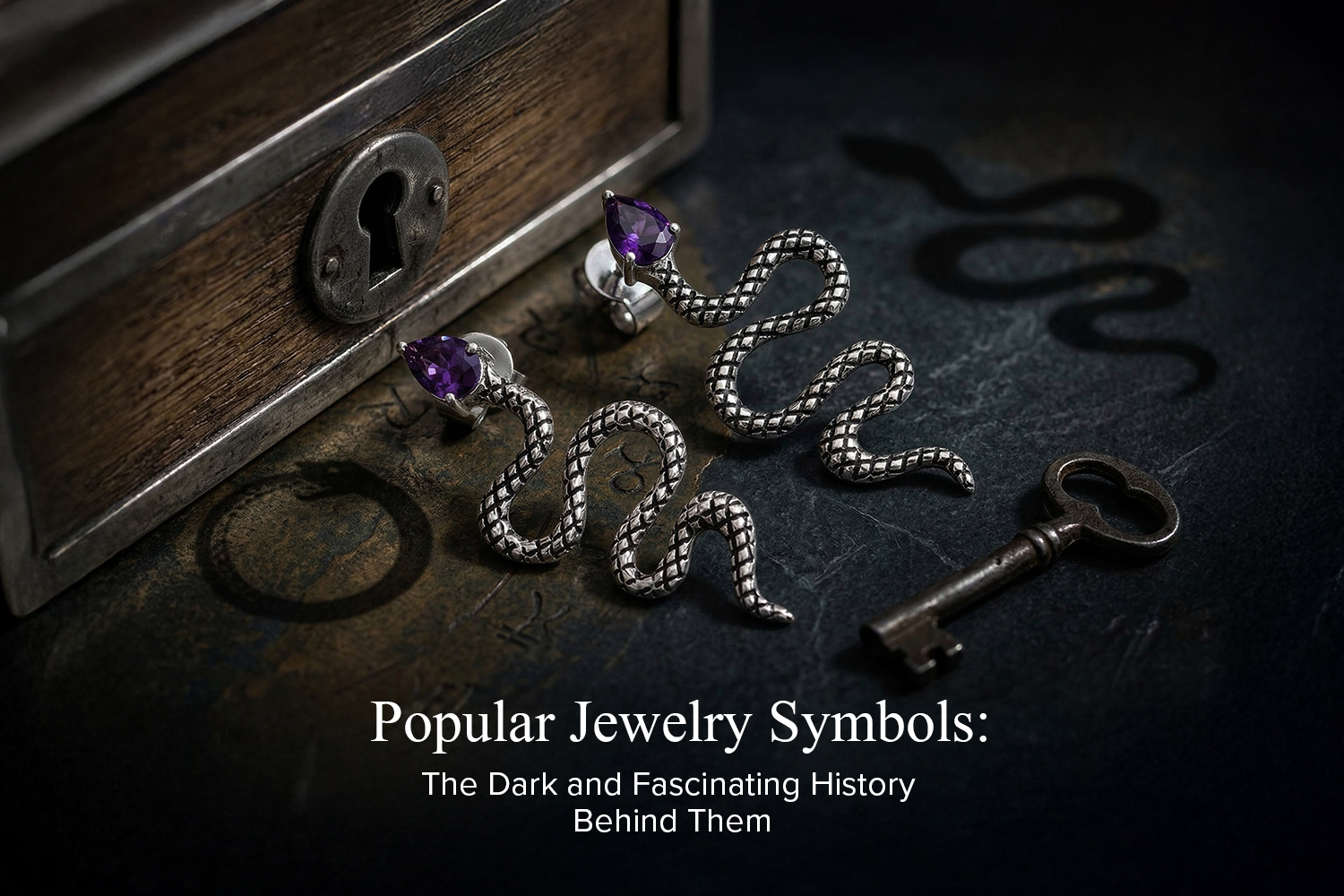
The serpent. Ancient Egypt, ancient Rome, Norse mythology, Indian tradition: the serpent appears across cultures as a symbol of transformation, wisdom, and cyclical renewal. A snake coiled into a ring is among the most enduring famous jewelry symbols in the Western tradition. The Serpent Eyes Ring, with its cat's eye quartz set in darkened silver, carries exactly this lineage: a symbol worn for centuries now held in hand-finished sterling silver with a stone that seems to look back.
-
The lotus. In Indian, Egyptian, and Buddhist traditions, the lotus represents purity, rebirth, and spiritual enlightenment, a flower that grows through mud and emerges immaculate. Ancient jewelry symbols featuring the lotus appear across thousands of years of decorative arts.
-
The hamsa. A palm-shaped symbol with an eye at the center, the hamsa is shared across Jewish, Islamic, and broader Middle Eastern traditions as a symbol of protection and good fortune. One of the most recognized popular jewelry symbols across the world today.
Ancient Jewelry Symbols and Their Meanings
Ancient jewelry symbols and meanings are often more complex than the simplified versions that survive in popular culture today.
-
The ouroboros, a serpent eating its own tail, was an ancient jewelry symbol used in Egyptian and later alchemical tradition to represent infinity, the cyclical nature of existence, and the unity of opposites. Contemporary jewelry often uses it as a simple symbol of eternity, which captures only part of what it originally meant.
-
The crescent and star, now associated primarily with Islamic iconography, predates Islam by thousands of years as a symbol used across Mesopotamian and Byzantine cultures. Ancient jewelry symbols and meanings like this remind us that symbols outlive the traditions that most recently adopted them.
-
The scarab, the ankh, the Eye of Horus: these ancient jewelry symbols have been adopted wholesale into global contemporary jewelry design, sometimes with their original meanings intact and sometimes stripped of context. Knowing their origins adds a layer of meaning that purely decorative wearing doesn't carry.
Hidden Meanings Behind Everyday Jewelry Symbols
Some of the most hidden meanings behind everyday jewelry symbols are the ones on pieces people wear without thinking much about.
-
The infinity symbol. Now ubiquitous in jewelry, the infinity sign has roots in mathematical philosophy representing the concept of endless continuation. In jewelry symbolism, it's commonly associated with eternal love or connection, though its original meaning is broader and more abstract.
-
The arrow. In various traditions, an arrow pointing forward symbolizes direction and purpose. An arrow pointing backward draws on its history as protection. Two arrows crossing represent friendship or alliance. The hidden meanings behind everyday jewelry symbols like the arrow depend heavily on orientation and context.
-
The moon. Lunar symbolism in jewelry is ancient and multilayered. The full moon represents completion and power. The crescent represents new beginnings and transition. The moon as a jewelry symbol also carries longstanding association with feminine energy and intuition across multiple cultural traditions. The Galeleian Two Faced Moon Necklace, with its natural black onyx embodying the shadowed mystery of the moon's dark side, carries this duality directly into wearable form.
-
The feather. In Egyptian tradition, the feather of Ma'at was used to weigh the heart of the deceased against truth and justice. In Native American traditions, feathers carry spiritual significance tied to communication with the divine. As a popular jewelry symbol today, the feather often signals freedom and lightness, carrying only a trace of its original jewelry symbolism.
Mystical Jewelry Culture: The Secrets Behind Jewelry Symbolism
Mystical jewelry culture is the broader world of belief that gives symbolic jewelry its power. Across traditions, the act of wearing a symbol wasn't considered passive. It was an active choice to align yourself with what that symbol represented.
In mystical jewelry culture, certain metals and stones were believed to amplify symbolic power:
-
Gold was associated with the sun, divine power, and immortality
-
Silver with the moon, intuition, and reflection
-
Amethyst was used across traditions for clarity and protection
-
Onyx was worn as a grounding stone, believed to absorb and transmute negative energy
The combination of a meaningful symbol in a resonant material was considered especially potent. The Midnight Runes Etched Necklace, with its darkened silver surface carrying intricate etched symbols, sits precisely at this intersection: a piece that feels like it was made to be worn with intention rather than simply admired.
Mystical jewelry culture also informs the wearing of amulets, pieces designed not for beauty but specifically for protection or intention. The line between an amulet and a beautiful piece of jewelry has always been thin. Many of the most popular jewelry symbols today, the evil eye, the hamsa, the moon, were originally amulets before they became aesthetic choices.
Jewelry symbolism in this context is not superstition. It's a way of making your relationship with the world material and wearable. A reminder, carried on the body, of what you value or what you're seeking.
Jewelry Symbolism in Modern Fashion
Jewelry symbolism in contemporary design is experiencing a genuine revival. After decades of purely decorative jewelry, there's a clear move back toward pieces with meaning. People want to know what they're wearing and why.
Popular jewelry symbols appear across every price point and style category in contemporary fashion:
-
Moon pendants for those drawn to lunar intuition and cycles
-
Evil eye pieces worn as protection against envy and ill will
-
Lotus rings as daily reminders of growth through difficulty
-
Serpent cuffs for those aligned with themes of transformation and renewal
The resurgence reflects a broader cultural interest in intentionality, in choosing things that carry weight rather than just looking good. At Bahlko, the influence of symbolic tradition shows up in how stone selection and design intersect. A druzy stone that looks like a geode, a form that itself evokes the hidden interior of the earth, carries a kind of visual symbolism even without a specific cultural reference. Jewelry symbols don't always need ancient precedent. Sometimes the symbol is in the material itself.
How to Choose Jewelry Symbols That Reflect Your Personality
Choosing popular jewelry symbols is most meaningful when the choice is genuinely personal rather than purely aesthetic.
-
Start with what resonates. Look at the famous jewelry symbols that appear across cultures and ask which ones feel aligned with how you think about the world or what you're currently navigating. A person in a period of transformation might be drawn to the serpent. Someone seeking clarity might choose the moon. Someone who values protection might reach for the evil eye or the hamsa.
-
Consider the history of jewelry symbols when making your choice. A symbol you understand carries more weight than one you're wearing for visual appeal alone. The additional context doesn't complicate the wearing. It deepens it.
-
Don't feel bound to a single tradition. Ancient jewelry symbols and meanings crossed cultural boundaries constantly throughout history. Wearing a symbol from a tradition that isn't your own, when done with genuine understanding and respect, is a continuation of that same movement.
The Winged Orb Moonlight Necklace, with its natural labradorite orb graced with angel wings in hand-finished silver, is a piece built around exactly this kind of layered symbolism: earth and sky, protection and flight, material and spirit, held together in one quietly powerful form.
FAQs
How did ancient jewelry symbols influence modern jewelry?
The history of jewelry symbols runs directly into contemporary design. Ancient jewelry symbols like the evil eye, the lotus, the serpent, and the crescent moon appear consistently in modern collections precisely because they were never fully abandoned. They passed through trade routes, religious traditions, and cultural exchanges and arrived in contemporary jewelry with their visual power largely intact. Most popular jewelry symbols today have direct lineage to ancient forms.
Which famous jewelry symbols are still popular today?
The most enduring famous jewelry symbols in contemporary jewelry are the evil eye, the hamsa, the moon and crescent, the lotus flower, the infinity symbol, the serpent, the feather, and the arrow. These appear across cultures and price points globally. Their persistence is a testament to the depth of meaning embedded in each form. Jewelry symbolism this consistent across time and geography reflects something real about what humans find meaningful.
What are the hidden meanings behind everyday jewelry symbols?
The hidden meanings behind everyday jewelry symbols are often richer than the simplified versions in circulation. The infinity symbol originally represented mathematical boundlessness rather than romantic eternity. The arrow has directional meaning depending on its orientation. The moon carries different meanings depending on its phase. Popular jewelry symbols like these reward closer attention. Understanding jewelry symbols at a deeper level doesn't make wearing them more complicated. It makes it more satisfying.
Popular jewelry symbols have survived thousands of years because they do something that purely decorative objects cannot: they carry meaning beyond their own form. They connect the personal to the cultural, the present to the ancient, the visible to the invisible.
The next time you reach for a piece with a moon, an eye, a lotus, or a serpent, you're participating in a tradition far older and wider than any single design trend. That's what makes popular jewelry symbols worth understanding, and worth wearing with intention.
When you're ready to find a piece that carries that same depth, explore Bahlko's handcrafted collection, where natural materials and considered design come together in pieces built to be worn with meaning.