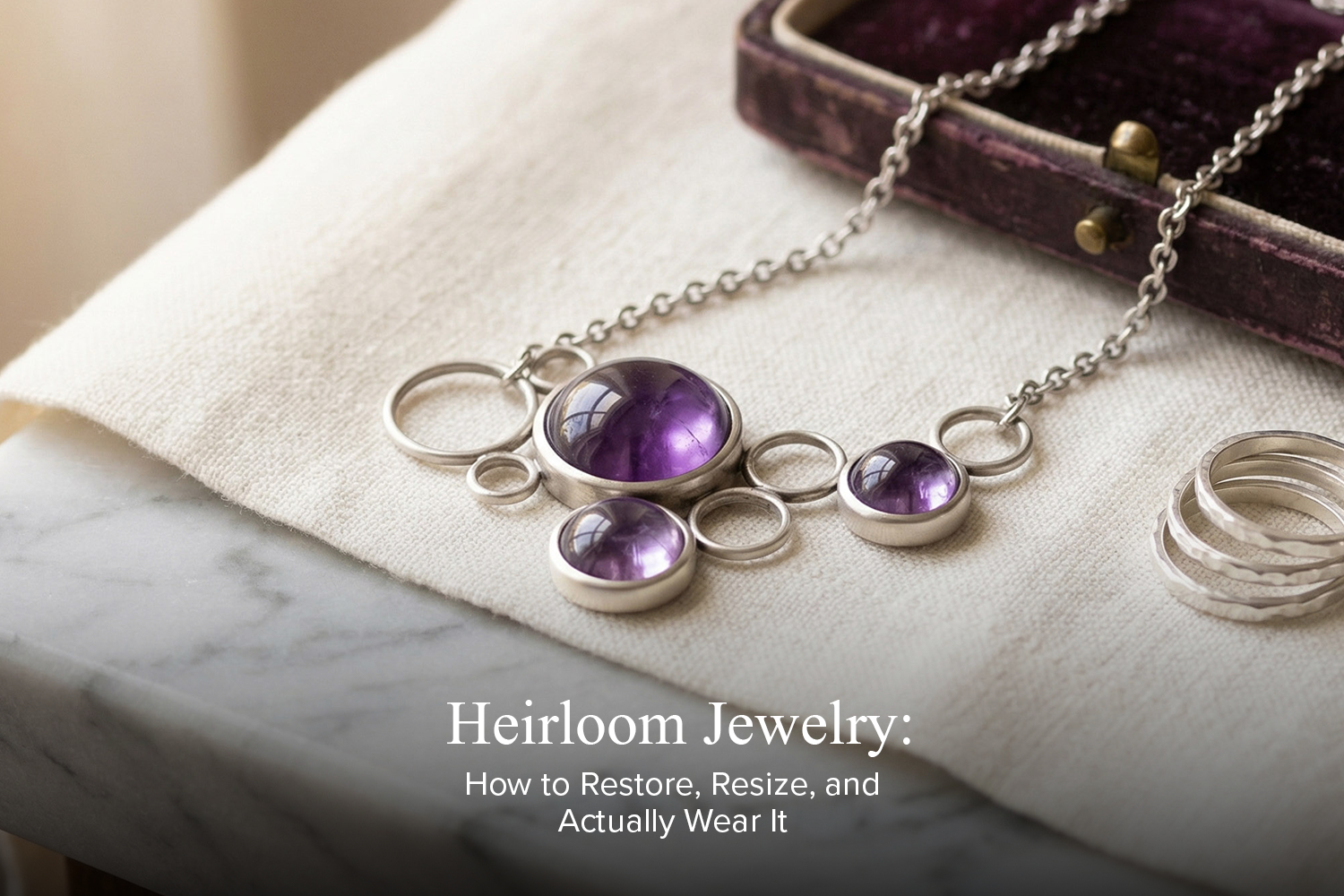
There's a ring sitting in a velvet box somewhere in most family homes. A necklace wrapped in tissue paper at the back of a drawer. A pair of earrings that belonged to someone who mattered, worn at a wedding decades ago, and then tucked away for safekeeping.
Heirloom jewelry has a way of accumulating without ever quite being worn. People keep it because it feels too precious to risk and too meaningful to sell. But the best thing you can do with heirloom jewelry is exactly what it was made for: wear it.
This guide is about how to actually do that. How to restore pieces that need attention, resize ones that don't fit, care for what you have, and bring old jewelry back into your daily life without feeling like you're doing something wrong.
What Is Heirloom Jewelry and Why It Matters
Heirloom jewelry is any piece passed down through generations or kept specifically to be passed down. It might be formally inherited, given at a milestone occasion, or simply found in a family member's belongings. The defining quality isn't age or monetary value. It's meaning.
What makes heirloom jewelry worth preserving is the story attached to it. A ring worn at a grandmother's engagement carries something no new piece can replicate. A bracelet bought in a city someone loved, worn through decades of their life, then passed to you, that's not just metal and stone. It's a physical record of a person.
Understanding this is the starting point for everything else. Heirloom jewelry deserves care not because it might be valuable in a financial sense, though it might be, but because it is a genuinely irreplaceable object.
How to Wear Heirloom Jewelry for Everyday and Special Occasions
The most common reason heirloom jewelry stays unworn is the fear of damaging something irreplaceable. It's understandable. But a piece kept permanently in a box isn't really being honored either.
How to wear heirloom jewelry depends on the piece and your lifestyle. A delicate antique ring might not suit daily manual wear, but it can absolutely come out for dinners, celebrations, and weekends. A sturdy gold bangle or a simple pendant necklace can often handle daily life without issue.
The key to knowing how to wear heirloom jewelry with confidence is understanding what the piece is made of and what it can handle:
-
Sterling silver and gold are durable and generally well-suited to regular wear
-
Stones in antique-style prong or bezel settings need more care than flush or pavé settings
-
Enamel and resin pieces are more vulnerable to knocks and should be worn with that in mind
Start by wearing the piece for short periods. See how it feels, how it holds up, and whether the setting is secure. That tells you more than any general rule.
For special occasions, heirloom jewelry is almost always the right choice over buying something new. A piece with genuine history reads differently from a recent purchase, and that difference is visible.
Heirloom Jewelry Restoration and Resizing Guide
Before you wear a piece that's been stored for years, it's worth having it assessed by a jeweler. This applies to most heirloom jewelry, regardless of how intact it appears.
Common restoration work includes:
-
Cleaning and polishing to remove buildup from years of storage
-
Re-tipping worn prongs to secure stones that have become vulnerable
-
Re-plating gold or rhodium finishes that have faded or worn through
-
Replacing lost or damaged stones with closely matched natural alternatives
-
Restringing pearl or bead necklaces where the original thread has weakened
-
Soldering cracked or broken bands to restore structural integrity
Resizing is one of the most practical things you can do with inherited rings. A ring in the wrong size simply won't be worn. Most rings can be resized up or down within a couple of sizes without affecting the piece significantly. Rings with stones set all the way around, like eternity bands, are more complex to resize and should be assessed individually.
When choosing a jeweler for restoration work on heirloom jewelry, look for someone with experience in antique and vintage pieces specifically. Modern setting techniques and antique construction methods are not always compatible, and an inexperienced jeweler can inadvertently damage what makes a vintage piece distinctive.
Vintage Jewelry Care: Preserving Classic Pieces
Vintage jewelry care starts with understanding what your piece is actually made of. Antique metals, settings, and stones often have different properties from contemporary jewelry, and the wrong cleaning method can cause real damage.
-
For most metal pieces, warm water, a small amount of mild soap, and a soft brush is the safest approach to vintage jewelry care. Avoid ultrasonic cleaners for antique pieces, as the vibration can loosen older settings. Avoid harsh chemical cleaners entirely.
-
For porous or organic stones such as pearls, opals, and turquoise, never submerge in water. Wipe gently with a damp cloth instead.
-
For storage, keep classic jewelry pieces individually in soft pouches or compartments so they don't scratch each other. Keep them away from direct sunlight and extreme temperatures, which can affect both metal and stone over time.
Sentimental Accessories: Caring for Pieces With Emotional Value
Sentimental accessories require the same physical care as any other fine jewelry, but they also deserve a layer of intentional attention that purely decorative pieces don't necessarily need.
-
Keep a record. Write down what you know about each piece of heirloom jewelry: who it belonged to, where it came from, any stories attached to it. This information is easily lost between generations and almost impossible to recover once it's gone. A simple note in the box or a photograph with a written description is enough.
-
Consider insurance for high-value sentimental accessories. Not because you plan to claim, but because having a formal valuation and record gives you options if something is lost or damaged.
-
Repair early. Small issues with sentimental accessories, a loose stone, a slightly bent prong, a worn clasp, become bigger problems if left unaddressed. The cost of early repair is almost always lower than the cost of significant restoration later.
Timeless Jewelry Gifts: Choosing Heirloom-Quality Pieces
If you're buying a gift with the intention that it might become heirloom jewelry someday, the criteria are slightly different from everyday jewelry shopping.
Timeless jewelry gifts are made in materials that last: sterling silver, gold, platinum. They have clean, considered designs that aren't rooted in a specific trend. They're made with visible craftsmanship, hand-setting, hand-finishing, attention to detail in the metalwork. And they carry meaning, either through the stone chosen, the occasion they mark, or the story attached to them.
The Grape Vine Necklace, a luminous tennis necklace with natural amethyst and citrine stones graduating from warm gold to deep violet, is exactly this kind of piece. Intricate enough to be unmistakably special, enduring enough in design to belong to any era. A piece someone would keep and eventually pass on.
Timeless jewelry gifts don't need to be expensive to become heirlooms. They need to be well-made and well-chosen. A simple oxidized silver ring with a natural stone, purchased at a significant moment in someone's life, carries the same potential for meaning as something far more elaborate.
Classic Jewelry Pieces Every Collection Should Include
Classic jewelry pieces are the ones that have staying power precisely because they weren't designed for a trend. A plain gold or silver band. A simple pendant necklace with a meaningful stone. A pair of small hoops. A delicate bangle. These are the classic jewelry pieces that people hold onto, pass down, and reach for across decades.
The Serpent Eyes Ring, with its cat's eye quartz set in darkened silver and its sculptural, quietly bold presence, is the kind of piece that belongs to no particular decade. You could imagine it on a dressing table in any era. That timelessness is exactly what makes a piece worth collecting, keeping, and eventually passing on.
When building a collection with longevity in mind, prioritize designs with clean lines and quality materials. Avoid pieces that are too specifically tied to a current aesthetic. The best classic jewelry pieces feel like they belong to no particular era, which is exactly what makes them timeless.
Inherited Jewelry Guide: Passing Down and Maintaining Family Treasures
An inherited jewelry guide needs to address both sides: receiving and passing on.
When you receive heirloom jewelry:
-
Take your time with it. Have it professionally assessed before wearing or cleaning it.
-
Learn what it is and what it's made of, and what its condition is before making any decisions.
-
Decide how you want it to live in your life, whether worn daily, kept for occasions, or eventually redesigned.
When you're thinking about passing pieces on:
-
Document everything you know, including the piece's history, any repairs or modifications made, and your wishes for how it should be used or kept.
-
Include context with the piece itself, a handwritten note, a photograph, or a simple record tucked into the box.
The inherited jewelry guide principle is simple: the more context you pass along with a piece, the more meaningful it becomes. Resizing, updating the setting, or combining stones from multiple pieces into one new design are all legitimate ways to modernize heirloom jewelry while keeping its essence. These decisions should be made thoughtfully, ideally in conversation with a trusted jeweler who understands the original piece.
Sentimental Jewelry Care Tips for Long-Lasting Beauty
A few sentimental jewelry care practices worth building into your routine:
-
Clean gently and regularly rather than intensively and rarely. Light maintenance prevents the buildup that requires harsher intervention later. This is the single most important sentimental jewelry care habit you can develop.
-
Remove jewelry before swimming, bathing, applying perfume or lotion, and before sleeping. These seem like small habits but they significantly extend the life of any piece.
-
Check settings periodically. Gently run a fingernail around any stone setting to check for looseness. If a stone moves, have it looked at before wearing the piece again.
-
Wear your heirloom jewelry. This is genuinely part of caring for it. Pieces that are worn regularly are also pieces that get checked, adjusted, and loved. The velvet box is not the safest place for something meaningful.
FAQs
Can heirloom jewelry be modernized without losing its value?
Yes, in most cases. Common modernization approaches for heirloom jewelry include resetting a stone in a new contemporary design, combining stones from multiple pieces into one, converting a brooch into a pendant, or updating a chain while keeping the original pendant. The monetary value of a piece typically lies in the metal weight and stone quality, both of which are preserved in most redesigns. The sentimental value is yours to decide about. Many people find that a modernized piece they'll actually wear carries more meaning than an original piece kept permanently in a box.
What makes a jewelry piece worth becoming an heirloom?
The qualities that make heirloom jewelry last generations are the same qualities that make any piece worth keeping: quality materials, skilled construction, meaningful design, and a story. A piece doesn't need to be antique or expensive to become an heirloom. It needs to be made well enough to survive time and carry enough meaning that someone will want to keep it. Classic jewelry pieces in sterling silver or gold with natural stone settings, made with visible craft, have both the physical durability and the aesthetic timelessness that heirloom pieces require.
Heirloom jewelry isn't meant to live in a drawer. It was worn by someone who mattered. It carries the weight of real life: of occasions, of relationships, of moments that can't be reconstructed.
Restore what needs restoring. Resize what doesn't fit. Learn how to wear heirloom jewelry as part of your actual life rather than as a relic from someone else's. The best way to honor a piece of heirloom jewelry is to let it be exactly what it was made to be: worn, loved, and eventually passed on with its story intact.
When you're ready to invest in a piece built with that same intention, explore Bahlko's handcrafted collection, made in sterling silver with natural gemstone settings, crafted to become the heirlooms of tomorrow.