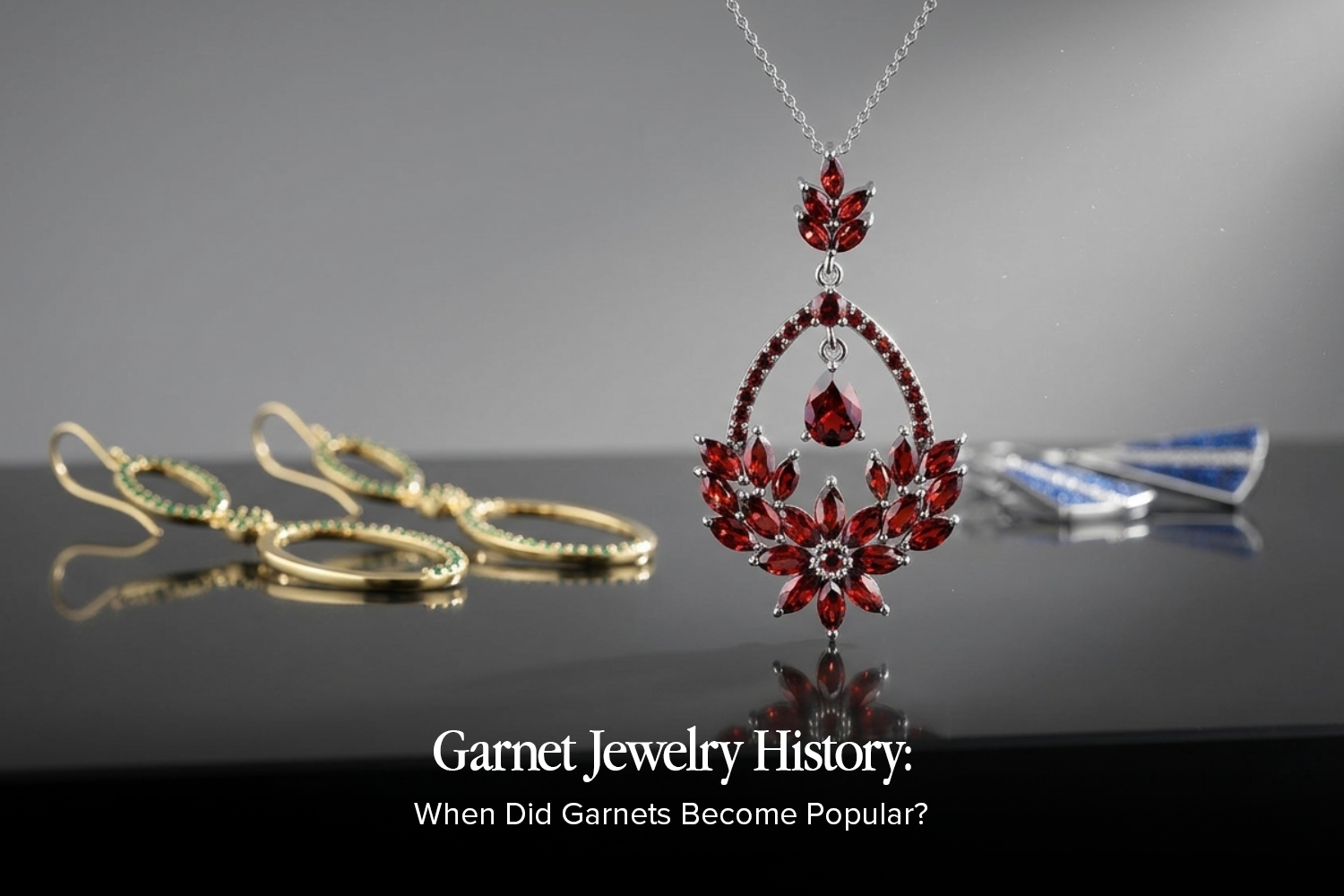
There is a moment, just before a gemstone is set, when it rests loose in the artisan’s palm. Light moves across its surface, not yet claimed by metal, not yet anchored into permanence. In that fleeting pause, a garnet holds centuries within it. This is where garnet jewelry history begins, not in timelines or textbooks, but in the quiet intimacy between stone and hand.
Across civilizations, this deep red gemstone has traveled further than most artifacts ever will. It has crossed deserts, adorned royalty, protected travelers, and found its place close to the human pulse. To understand garnet jewelry history is to follow a story that refuses to stay still.
What Is The History Of Garnet Gemstone Jewelry
The earliest chapters of garnet jewelry history trace back over 5,000 years, to ancient Egypt, where garnets were buried with pharaohs as companions for the afterlife. They were not seen as ornaments. They were seen as guardians.
In Rome, signet rings carved with garnets sealed important documents. These were not decorative choices. They were symbols of identity, authority, and permanence. The stone carried meaning long before it carried shine.
This is where the question of what is the history of garnet gemstone jewelry becomes more than curiosity. It becomes a study of how humans have always sought to embed belief into beauty.
As trade routes expanded, garnets moved through Asia and Europe, each culture shaping its significance differently. In India, the stone found resonance within a legacy of gemstone mastery that continues to influence how artisans approach their craft today. The lineage of stone cutting, polishing, and setting techniques refined over decades echoes this long journey.
Even today, when one encounters pieces like intricately crafted garnet birthstone jewelry, the connection to these ancient practices feels intact. The stone may be newly set, but its story is anything but new.
When Did Garnets Become Popular Across Civilizations
To ask when did garnets become popular is to recognize that popularity, in this case, is not a trend but a recurring return.
Garnets saw widespread prominence during the Bronze Age, particularly among the Greeks and Romans. Later, during the Middle Ages, European nobility favored garnets for their deep, wine-like hue, often associating them with protection and vitality.
The question of when did garnets become popular across civilizations finds multiple answers because garnets never truly disappeared. They resurfaced in different eras, each time carrying new interpretations.
During the Victorian era, red garnet rings became particularly significant. They were exchanged as tokens of affection, loyalty, and remembrance. The stone’s warmth mirrored emotional depth, making it a natural choice for intimate pieces.
Even now, the resurgence of interest in types of garnet gemstones has brought renewed attention to their versatility. From deep crimson to subtle orange and green variations, garnets continue to evolve without losing their identity.
This cyclical relevance is what makes garnet jewelry history distinct. It is not linear. It breathes, pauses, and returns.
Garnet Gemstone Meaning: Symbolism And Significance
There is a reason garnets have remained close to the body throughout history. The garnet gemstone meaning has always been deeply personal.
Traditionally, garnets were believed to symbolize protection, grounding, and passion. Travelers carried them as talismans. Warriors wore them into battle. Lovers exchanged them as promises.
The enduring nature of garnet gemstone meaning lies in its duality. It is both protective and expressive. It guards, yet it reveals.
In contemporary contexts, this meaning translates into pieces that feel intentional. When someone chooses garnet birthstone jewelry, it is rarely accidental. It reflects a desire to wear something that holds emotional weight.
This is where garnet jewelry history continues to shape modern design philosophy. The stone is not chosen for aesthetics alone. It is chosen for what it carries.
Red Garnet Rings: A Classic Jewelry Tradition
Few forms have carried the legacy of garnets as consistently as red garnet rings. Circular, continuous, and worn close to the pulse, rings have always been vessels of meaning.
Historically, red garnet rings symbolized commitment and trust. In some cultures, they were exchanged before long journeys, believed to ensure safe returns.
Today, their appeal lies in their quiet intensity. A well-crafted garnet ring does not compete for attention. It holds it.
Pieces such as finely detailed settings that frame the stone with sculptural precision echo the philosophy that detail is devotion. A thoughtfully designed garnet ring, like those found within curated collections of artisan-crafted jewelry, becomes more than a piece. It becomes a narrative held in metal and stone.
Within this context, the evolution of garnet jewelry history becomes visible in form. The craftsmanship may refine, the settings may evolve, but the essence remains unchanged.
Garnet Birthstone Jewelry: Origins And Cultural Importance
January’s association with garnets has deep historical roots. Garnet birthstone jewelry is not a modern assignment. It emerges from ancient traditions that linked gemstones to celestial cycles and human identity.
The use of garnet birthstone jewelry reflects a belief that stones carry energies aligned with specific times of the year. For those born in January, garnets symbolize strength, stability, and inner clarity.
Across cultures, gifting garnet birthstone jewelry has represented more than celebration. It has been an offering of protection and intention.
This connection between time, identity, and stone reinforces the enduring relevance of garnet jewelry history. It shows how deeply embedded these gemstones are in human rituals.
Difference Between Red Garnet And Other Red Gemstone Jewelry
At first glance, many red gemstones appear similar. Yet the difference between red garnet and other red gemstone jewelry becomes evident upon closer observation.
Garnets possess a depth that feels almost internal, as though the color originates from within rather than reflecting off the surface. This distinguishes them from other stones that rely more heavily on brilliance.
Understanding the difference between red garnet and other red gemstone jewelry is essential for appreciating their uniqueness. Garnets are not defined by sparkle alone. They are defined by presence.
Among the many types of garnet gemstones, variations in color and composition further highlight their diversity. From the classic deep red to rarer green and orange hues, garnets offer a spectrum that extends beyond expectation.
This diversity strengthens the narrative of garnet jewelry history, proving that even within a single gemstone family, there is room for endless exploration.
FAQs
What makes garnet gemstone jewelry historically significant?
Garnet gemstone jewelry is historically significant because it has been used across civilizations for over 5,000 years. From ancient Egyptian burial rituals to Roman signet rings, garnets have consistently symbolized protection, identity, and emotional depth. This enduring presence is what defines garnet jewelry history as both cultural and personal.
When did garnet become a popular choice in jewelry?
The question of when did garnet become popular does not have a single answer. Garnets gained prominence during the Bronze Age and remained popular through the Roman, medieval, and Victorian eras. Their repeated resurgence across time is a defining feature of garnet jewelry history.
How is red garnet different from other red gemstones?
The difference between red garnet and other red gemstone jewelry lies in its depth and tone. Garnets have a rich, internal glow that sets them apart from other red stones. Additionally, the variety within types of garnet gemstones offers more diversity than most people expect.
There is something quietly powerful about a gemstone that has never needed reinvention.
To trace garnet jewelry history is to witness how certain materials outlast trends, outlive eras, and remain relevant without asking for attention. They do not adapt to time. Time adapts to them.
And perhaps that is what draws us back to garnets, again and again. Not because they are new. But because they have always been.