Before it became a gemstone, it was a sky.
Not metaphorically, almost literally. When ancient civilizations first held lapis lazuli in their hands, they believed they were touching a fragment of the heavens. That particular shade of midnight blue, shot through with veins of gold, was unlike anything the earth had offered before. It did not look mined. It look
ed borrowed from somewhere far more sacred.
So what is lapis lazuli, exactly? And why has this ancient blue gemstone held the world in quiet reverence for over six thousand years?
Lapis Lazuli Stone History: Origins and Ancient Use
The lapis lazuli stone history stretches back to at least 4000 BCE, rooted in the mines of Badakhshan, a remote, mountainous province in what is now northeastern Afghanistan. For millennia, those mines were the singular source of the world's finest lapis, feeding trade routes that wound through Mesopotamia, Egypt, the Indus Valley, and eventually Rome.
The stone traveled because it was worth traveling for.
In ancient Mesopotamia, lapis lazuli was ground into powder to produce the world's first blue pigment, a color so rare and so costly that it was reserved for the divine. In Egypt, it was carved into amulets, inlaid into pharaonic death masks, and placed beside the bodies of kings to accompany them into the afterlife. Tutankhamun's iconic funerary mask carries lapis across his brow. Cleopatra reportedly used ground lapis as eyeshadow, making it, arguably, the original luxury cosmetic.
The history of the lapis lazuli stone is not a single story. It is thousands of them, stitched together across continents and centuries by the shared recognition that this stone meant something. It was never merely decorative. It was always devotional.
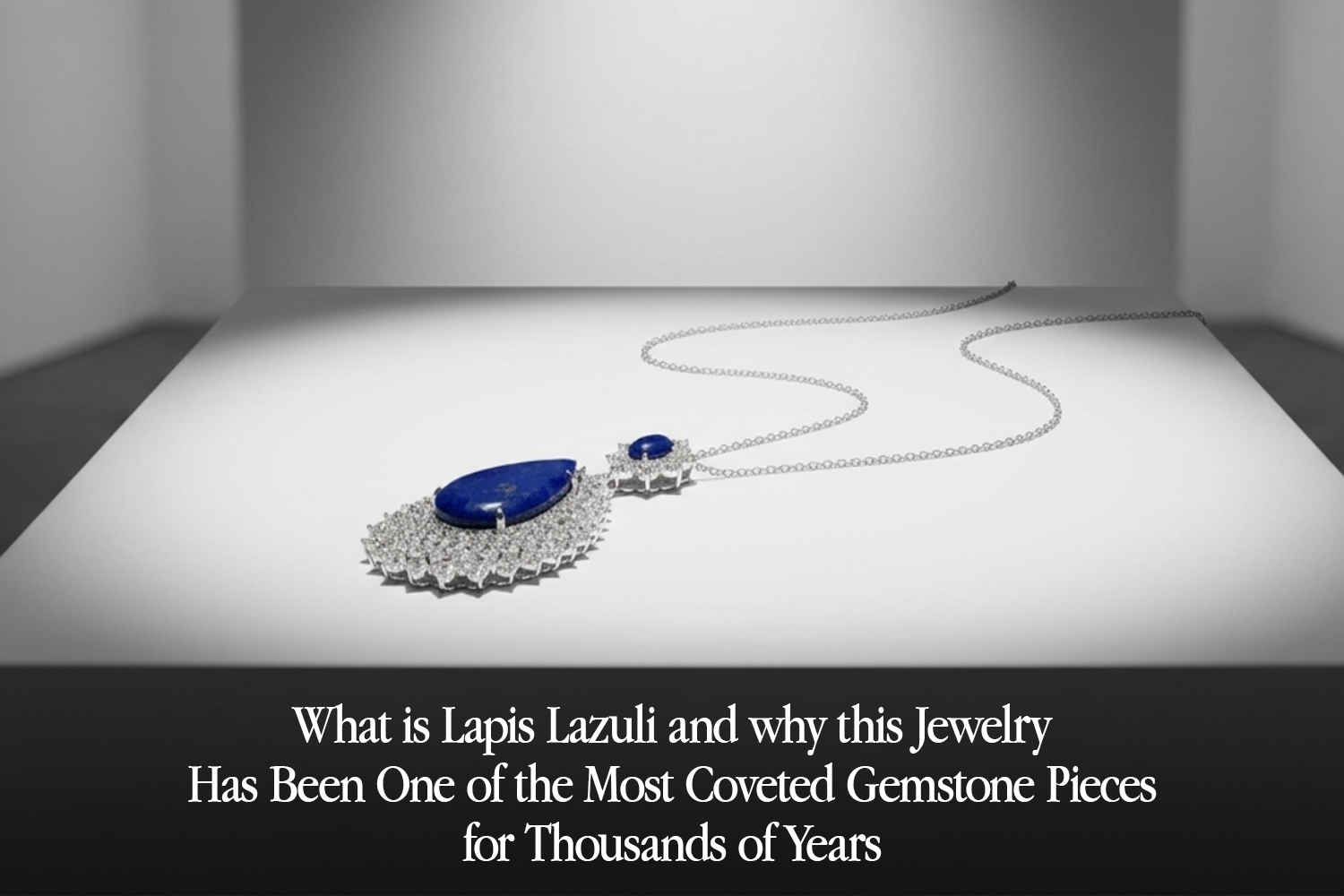
At Bahlko, where 35 years of gemstone mastery shape every piece we create, this reverence is not performative. It is inherited. Our artisans understand that to set a stone is to continue a conversation that began long before any of us arrived. Explore the lapis lazuli pendants in our handcrafted gemstone pendant collection to see how that conversation continues today.
Why Is Lapis Lazuli Blue: Composition and Color Explained
Why is lapis lazuli blue? The answer lives in its geology.
Lapis lazuli is not a single mineral. It is a metamorphic rock composed primarily of lazurite, the mineral responsible for its iconic deep blue. The intensity of that blue shifts depending on the concentration of lazurite present. The finest specimens carry an almost violaceous depth, like the sky just before it surrenders to night.
The golden flecks that scatter across its surface are pyrite, iron sulfide catching light the way stars press through dark. White calcite occasionally streaks through in soft veins. Together, these three elements create a stone that does not look manufactured. It looks composed, the way a great piece of music is composed: individual notes working in harmony toward something larger than any of them alone.
Why is lapis lazuli blue in a way that feels different from other stones? Because it does not reflect light so much as absorb it, holding the color inward, releasing it slowly. It is a stone that rewards patience. The longer you look, the more you see.
For those drawn to that depth of blue, Bahlko's Aqua Starfish Necklace explores a similar oceanic spectrum through natural Swiss Blue Topaz, another stone that carries the quiet gravity of deep water.
What Was Lapis Lazuli Used for in Ancient Times
What was lapis lazuli used for in ancient times? Almost everything that mattered.
As pigment: ground into ultramarine, lapis lazuli was the most prized blue in the medieval European painter's palette. It cost more than gold, which is why Renaissance artists reserved it for the robes of the Virgin Mary. The stone did not just influence art. It financed devotion.
As medicine: ancient physicians believed lapis lazuli held healing properties. Ground and mixed with other materials, it was used in remedies for fevers, infections, and ailments of the spirit as much as the body.
As status: in ancient Sumer and Babylon, lapis lazuli jewelry marked rank. Cylinder seals, royal necklaces, and votive offerings were carved from the stone because its rarity conferred legitimacy. To wear it was to announce proximity to power.
As a symbol: the ancient blue gemstone carried spiritual weight across nearly every civilization it touched. In ancient Egypt, it represented truth and the heavens. In Buddhism, lapis lazuli is the color associated with the Medicine Buddha, a symbol of healing, clarity, and the dissolution of delusion.
What was lapis lazuli used for in ancient times is really a question about what ancient peoples believed a stone could hold. And the answer, across culture after culture, was: almost everything.
Those who are drawn to stones with oceanic quietude and layered meaning will find a kindred spirit in Bahlko's Aqua Whisper Octopus Pendant, which centers a natural Larimar stone in a sculptural silver setting, honoring the same union of beauty and depth that made ancient blue gemstones so prized.
Ancient Blue Gemstone: Cultural and Historical Importance
Across six thousand years of recorded use, no ancient blue gemstone has accumulated the cultural gravity of lapis lazuli.
The ancient blue gemstone made its way into the Epic of Gilgamesh, one of humanity's earliest known works of literature, where it appears as a symbol of divine favor and enduring beauty. It was discovered in burial sites across the ancient world, carried into tombs by civilizations that had no contact with each other, as if, independently, they had all arrived at the same conclusion: this stone belongs with the sacred.
It traveled the Silk Road. It moved through the hands of merchants, priests, artists, and rulers. And at every stop, it acquired new meaning without losing the old.
The Mughal emperors of India used lapis lazuli to adorn architecture and personal regalia. The ancient blue gemstone appears in the pietra dura inlays of Mughal tombs, blue against white marble, a contrast that still stops visitors in their tracks. For a stone whose story begins in the mountains of Afghanistan, its resonance in South Asian artisanship is both profound and personal.
It is this layered cultural inheritance that makes lapis lazuli more than a gemstone. It is a living archive. Every piece carries millennia of meaning, and a jeweler who works with it is not simply setting stone. They are handling six thousand years of human devotion.
Lapis Lazuli vs Other Blue Gemstones: Key Differences
How does lapis lazuli stand in the company of other blue gemstones? The comparison reveals as much about the others as it does about lapis itself.
Here are the key distinctions worth knowing:
-
Color origin: Sapphire's blue comes from trace elements of iron and titanium within a single crystalline structure. Lapis lazuli's blue is the result of a metamorphic convergence of multiple minerals, lazurite, pyrite, and calcite, each contributing to a color that is richer and more complex in composition.
-
Surface quality: Sapphire is transparent; its brilliance comes from refraction. Aquamarine is translucent, its blue cool and watery. Lapis lazuli is opaque. It does not sparkle in the conventional sense. It glows, depth without transparency.
-
Cultural lineage: Blue topaz and blue tourmaline are relative newcomers to the jewelry canon. Lapis lazuli vs other blue gemstones is not a fair comparison in terms of age. Lapis has been in continuous use for six thousand years. That longevity is embedded in its value.
-
Texture and finish: When polished, lapis lazuli takes on a smooth, almost velvety surface. It does not dazzle. It commands, quietly, without effort, the way old authority always does.
The lapis lazuli vs other blue gemstones conversation often ends the same way: the others may be rarer or more brilliant, but none of them carry a story quite like this one. For those who want to build a collection around the full spectrum of blue, Bahlko's Aquatic Bush Vine Pendant, set with natural Larimar and Blue Topaz in lustrous silver, offers another chapter in that conversation.
Lapis Lazuli in Jewelry and Art Through History
The history of lapis lazuli in jewelry is, in many ways, the history of jewelry itself.
Lapis lazuli has adorned humanity since the earliest moments of adornment, carrying its quiet significance from ancient burials to refined courtly expression.
Across eras, from Egyptian gold to Art Deco geometry, it remains a stone that does not demand attention, but holds it with effortless depth.
The 20th century brought lapis lazuli into Art Deco settings, geometric, architectural, and dramatic. Cartier and Van Cleef used it in bold compositions that stripped away historical reference and let the stone's color speak without ornament.
And today, lapis lazuli continues to be set by artisans who understand what they are holding. The weight of the stone. The weight of its story.
At Bahlko, where 35 years of gemstone mastery inform every piece, lapis lazuli is approached with the reverence it has always been due. Each stone is hand-selected for the particular quality of its blue, not uniformly dark, not washed out, but alive. Set by hands that carry decades of inherited knowledge, in pieces designed not to be noticed for their novelty, but remembered for their depth. Browse the full range of natural gemstone pendants to find the piece that holds your story.
Conclusion
Some stones are beautiful. Some stones are rare.
And some stones are both of those things, and something more, witnesses to six thousand years of human longing for color, meaning, beauty, and the kind of permanence that outlasts any single life.
Lapis lazuli is that stone.
To wear it is not to own a piece of the earth. It is to carry a piece of a very long story, and to add, quietly, your own chapter to it.
Explore Bahlko's handcrafted gemstone collections, where every piece is chosen with the understanding that the stones we carry say something about who we are, and who we are becoming.
Frequently Asked Questions
Why was lapis lazuli important in ancient civilizations?
It symbolized divinity, power, and protection through its rare, celestial blue.mIts presence across cultures reflects a shared spiritual significance.
What gives lapis lazuli its deep blue color?
Lazurite gives it its rich blue depth. Pyrite and calcite add natural texture and contrast.
How does lapis lazuli differ from other blue gemstones?
It is an opaque, multi-mineral stone, unlike most blue crystals. Its history and depth make it feel timeless and introspective.