You know that moment when you are browsing rings and suddenly the description starts sounding like a biology textbook?
Shank. Cathedral. Euro. Knife edge. Bypass.
And you are like, I just want a ring that looks good and feels good. Same.
So let’s simplify it. What does ring shank mean?
It is the part of the ring that wraps around your finger. People often call it the band, but “shank” is the proper term in jewelry language, especially when we talk about structure and design details.
And yes, the shank is not a tiny detail. It changes everything:
→ how the ring feels
→ how secure the center stone looks
→ how the ring sits on your finger
→ how it wears over years
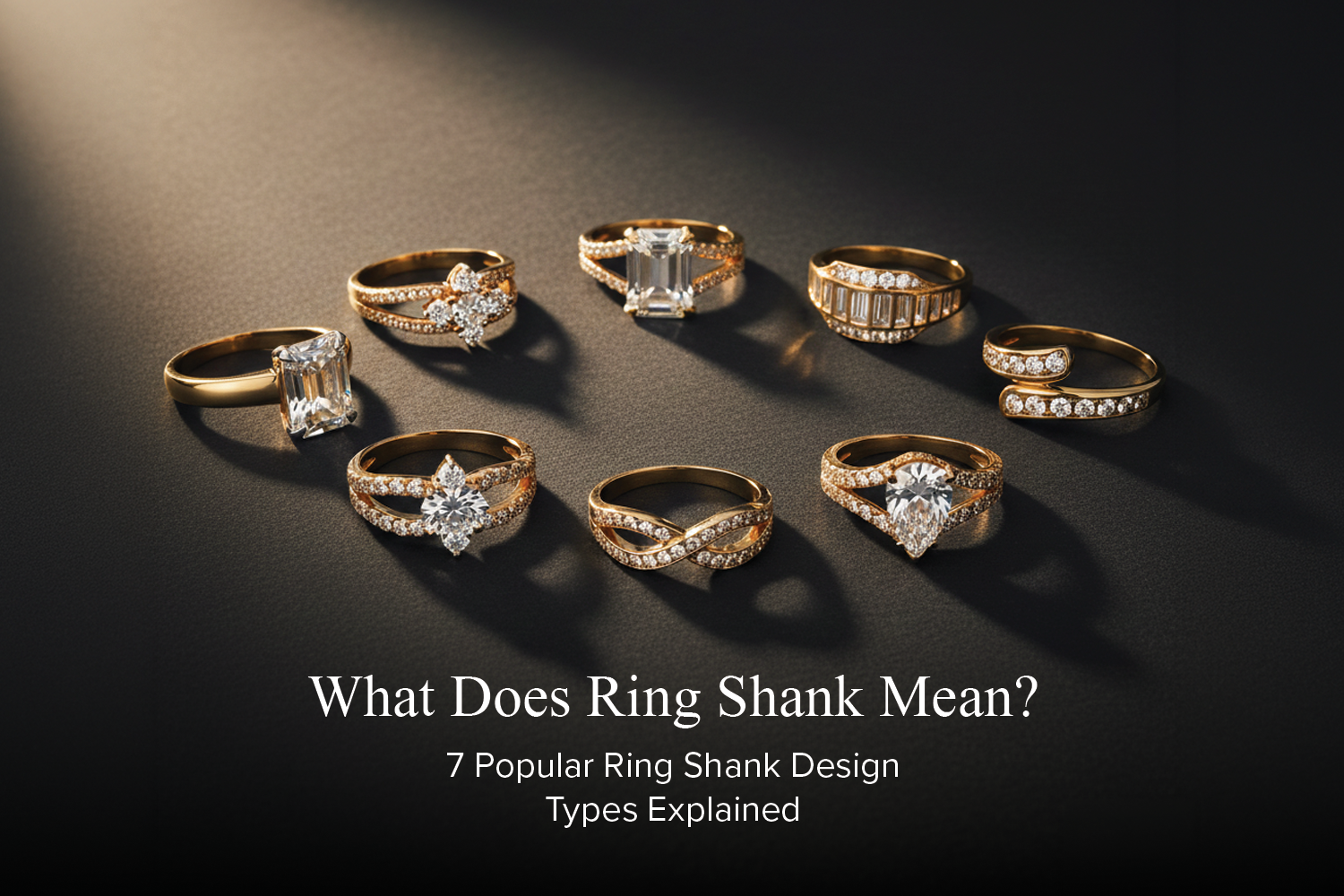
This guide breaks down seven popular shank designs, in a way that is easy to read and actually helpful.
Table of content
→ Why Understanding Ring Styles Helps You Build a Timeless Collection
→ Cathedral Shank: Elevated Arches for Drama and Stone Protection
→ Split Shank: Modern Bifurcated Bands That Frame Your Gemstone
→ Tapered Shank: Classic Narrowing for Elegant Proportions
→ Bypass Shank: Contemporary Curves That Embrace the Center Stone
→ Knife Edge and Euro Shank: Sharp Modernity vs Rounded Comfort
→ Twisted Shank: Textured Romance and Vintage-Inspired Appeal
→ How Shank Design Affects Comfort, Fit and Daily Wearability
→ How Bahlko Crafts Ring Shanks That Balance Beauty and Strength
→ Conclusion
→ FAQs
Why Understanding Ring Styles Helps You Build a Timeless Collection
If you are buying rings more intentionally now, learning a little jewelry language helps.
Because when you know the terms, you stop choosing randomly. You start choosing with clarity.
That is the whole point of a good jewelry terminology guide. It gives you control.
And in rings, the shank is one of the most important ring structure components. It holds the setting, carries the weight, and decides how comfortable the piece feels daily.
So if you have been wondering what does ring shank mean, think of it like this:
→ the shank is the foundation
→ the setting is the spotlight
→ the stone is the story
This is also why ring band anatomy explained content is useful. It makes you a smarter buyer, especially for engagement rings and daily-wear rings.
Cathedral Shank: Elevated Arches for Drama and Stone Protection
A cathedral shank has arches that rise up toward the center stone. The band literally “lifts” into the setting, creating a dramatic, elevated look.
Why people love cathedral shanks:
→ they make the center stone look more prominent
→ they offer extra structural support
→ they feel classic but still bold
This is where the comparison cathedral setting vs split design becomes useful. Cathedral is about upward arches. Split is about dividing the band.
If you are shopping for engagement styles, this is part of engagement ring anatomy that changes the overall silhouette. Cathedral rings can look more formal and architectural.
So yes, if you are learning what ring shanks mean, a cathedral is one of the first design types you will notice once you start paying attention.
Split Shank: Modern Bifurcated Bands That Frame Your Gemstone
A split shank means the band divides into two (or more) strands as it approaches the center setting. It frames the stone and adds visual width without making the ring feel bulky.
Why split shanks are popular:
→ they look modern and detailed
→ they can make the center stone feel bigger
→ they add design interest even with a simple stone
This is the other side of the cathedral setting vs split design conversation. Split shanks feel more contemporary and design-forward. Cathedral shanks feel more classic and elevated.
Split shanks are also a key part of ring band anatomy explained because the split affects structure and potential resizing options later.
And yes, understanding what does ring shank mean helps you recognize why split shanks look so different from a standard band. They are built to guide your eye toward the center.
Tapered Shank: Classic Narrowing for Elegant Proportions
A tapered shank gets narrower as it moves toward the center stone. This creates a very flattering proportion, especially on the hand.
This is where tapered band characteristics matter. Tapering can:
→ make the center stone feel larger
→ create a lighter look on the finger
→ feel more elegant and less heavy
People choose tapered designs because they look balanced. They work with classic stones, modern stones, and even more ornate settings.
In terms of ring structure components, tapering is a design choice that also affects comfort. A tapered shank often feels less bulky near the top, which many people prefer for daily wear.
If you keep asking what does ring shank mean, tapered shanks are a great example of how the shank is not just “the band.” It is a style decision.
Bypass Shank: Contemporary Curves That Embrace the Center Stone
A bypass design looks like the band curves around the stone instead of meeting symmetrically. It creates movement, like the ring is hugging the center.
This is where bypass ring construction becomes the defining feature. The band shape is the design, not just the stone.
Why people love bypass styles:
→ they look unique and modern
→ they create a fluid, sculptural feel
→ they stand out without needing a huge stone
In engagement ring anatomy, bypass designs are often seen as more non-traditional. They can also be very flattering on the finger because of the curve and flow.
If you are learning what does ring shank mean, bypass is one of the most obvious examples of the shank being the main design moment.
And yes, bypass ring construction requires good craftsmanship because curves need balance, stability, and comfort.
Knife Edge and Euro Shank: Sharp Modernity vs Rounded Comfort
This is a comparison that confuses a lot of people, but it is actually simple.
A knife edge shank has a raised ridge down the center of the band. It creates a sharp, defined line and often looks modern and sleek. A euro shank usually has a slightly squared-off bottom, which helps reduce spinning and can feel more stable on the finger.
This is where knife edge vs euro shank is a helpful phrase. The difference is both visual and practical. Also, comfort matters. Many people ask about comfort fit band benefits when choosing bands they will wear daily. Comfort fit usually means the inside of the band is slightly rounded, which can feel smoother on the finger.
So when comparing knife edge vs euro shank, also consider comfort. A sharp ridge can look beautiful, but you may prefer a softer inner curve, especially for everyday wear.
If you are still wondering what does ring shank mean, this section shows why terminology matters. Two rings can look similar from far away, but feel totally different in daily life.
Twisted Shank: Textured Romance and Vintage-Inspired Appeal
A twisted shank looks like the band is braided or woven. It adds texture, depth, and movement, even if the center stone is simple.
This is where twisted band jewelry styles become a whole category. Twists can look:
→ romantic
→ vintage-inspired
→ detailed without being heavy
Twisted bands are also great if you want your ring to have personality from every angle. They look interesting even when your hand is at rest.
In terms of ring band anatomy explained, twists can affect resizing and maintenance, depending on how intricate the twist is. But visually, they are stunning.
If you are learning what does ring shank mean, twisted designs are a perfect reminder that the shank is not boring. It can be the most expressive part of the ring.
How Shank Design Affects Comfort, Fit and Daily Wearability
This is the part that matters most, especially if you plan to wear your ring often.
Shank design affects:
→ how the ring feels against the finger
→ how much it spins
→ whether it snags on clothes
→ how it sits next to other rings
→ how easy it is to resize later
If comfort is your priority, explore comfort fit band benefits. Comfort fit bands can feel smoother, especially if you wear rings daily.
If you want stability, euro shanks can help reduce spinning. That is why knife edge vs euro shank is not just aesthetic, it is practical.
If you want a very modern structure, split or bypass styles can change the feel completely. That is why knowing ring structure components helps you choose with intention.
So yes, if you came here asking what does ring shank mean, the real answer is: it is the part that decides whether you will love wearing the ring, not just looking at it.
How Bahlko Crafts Ring Shanks That Balance Beauty and Strength
Bahlko comes from gemstone mastery through Vision Gems, and craftsmanship matters most in the parts people do not always notice first.
The shank is one of those parts.
A beautiful ring needs a shank that is:
→ balanced in weight
→ well-finished for comfort
→ strong enough to support the setting
→ proportioned to look elegant on the hand
This is where ring band anatomy explained becomes real. A well-made shank feels smooth and stable, and it supports the design rather than fighting it.
Bahlko focuses on making pieces that feel wearable and lasting. Not just pretty in photos. That approach shows in the attention to ring structure components, especially in designs that include curves, splits, or intricate twists.
And yes, if you are buying engagement jewelry, craftsmanship is the quiet difference in engagement ring anatomy that you feel every day.
Conclusion
So, what does ring shank mean?
It is the band of the ring, the part that wraps around your finger and supports everything else.
But more importantly, it is the design choice that changes comfort, structure, and style.
Cathedral shanks lift and protect.
Split shanks frame and modernize.
Tapered shanks refine proportions.
Bypass shanks add sculptural movement.
Knife edge and euro shanks change feel and stability.
Twisted shanks add texture and romance.
Once you understand shanks, you stop shopping blindly. You start choosing rings that match your lifestyle and your aesthetic.
And that is the whole point.
FAQs
What part of a ring is called the band?
The band is the circular part that wraps around your finger. In jewelry terms, this is often called the shank, especially when discussing structure and design.
How do different band styles affect ring comfort?
Band shape, width, and inner curve affect comfort. Rounded interiors and balanced proportions often feel smoother, which is why comfort-fit designs are popular for daily wear.
Which ring band design is most durable for everyday wear?
Durability depends on metal thickness, structure, and finishing. Simpler, well-constructed bands with secure settings usually hold up best, especially for active lifestyles.
Can I resize rings with decorative band designs?
Many rings can be resized, but intricate details like twists or split designs can limit how much adjustment is possible. It is best to check resizing flexibility before buying.
What's the difference between split and bypass band styles?
Split bands divide into two strands near the center, framing the stone. Bypass styles curve around the center and create a more fluid, asymmetrical look.